Is F1 Casino worth playing for New Zealand players?
An educational look at how this offshore platform operates for New Zealand players — bonuses, banking, pokies and licensing context.
Last updated: 14 July 2026
F1 Casino is an offshore online gaming platform that has attracted attention from Kiwi players searching for pokies, table games and live dealer options outside New Zealand's borders. This F1 Casino review takes an educational approach, explaining how the site operates, what New Zealand's incoming licensing regime means for players right now, and what to check before depositing at any offshore operator. Rather than promoting the platform, this guide aims to help readers make an informed decision grounded in facts about licensing, banking, and player protection.
For New Zealand readers, timing matters. The country is in the middle of a major regulatory shift, and understanding where F1 Casino NZ sits in that landscape is essential before considering any online casino gaming.
Overview
Bonuses at F1 Casino

Bonuses are often the first thing players look at when researching an online casino New Zealand offer, and F1 Casino bonus promotions typically follow the standard structure used across offshore operators: a welcome package for new accounts, followed by ongoing reload offers, free spins on selected pokies, and loyalty-based perks. Understanding the mechanics behind these offers is more useful than simply comparing headline numbers, because the real value of a bonus is determined by its conditions, not its size.
Wagering requirements are the central mechanic to understand. A wagering requirement (commonly written as 30x, 40x, or similar) tells you how many times the bonus amount, or the bonus plus deposit combined, must be played through before any winnings can be withdrawn. A NZD 500 bonus with a 40x requirement means NZD 20,000 in total wagering before a withdrawal request can be processed. This single figure often matters more than the bonus size itself.
Typical bonus terms to check
Before opting into any F1 Casino bonus, it is worth reviewing the terms attached to it in the same way you would read a contract. Offshore operators are not bound by New Zealand consumer law, so the promotional terms published by the operator are the only protection a player has.
- Wagering requirement multiplier and whether it applies to the bonus only or bonus plus deposit
- Maximum bet size allowed while a bonus is active (breaching this can void winnings)
- Game weighting — pokies often count 100% toward wagering, table games far less
- Maximum cashout cap attached to free spins or no-deposit offers
- Time limit to clear the wagering requirement, typically 7 to 30 days
A practical red flag to watch for is a bonus that looks unusually generous relative to its category. Extremely high match percentages paired with steep wagering multipliers and low maximum cashouts tend to favour the house far more than a moderate offer with fair terms. Reading the full terms and conditions page, not just the promotional banner, is the only reliable way to assess this.
| Bonus type | Typical structure | What to verify |
|---|---|---|
| Welcome match bonus | 100%-200% up to a set NZD-equivalent cap | Wagering multiplier, expiry window |
| Free spins package | Fixed spin count on selected pokies | Game restriction, max win cap |
| Reload bonus | Smaller match on repeat deposits | Frequency limits, minimum deposit |
| Loyalty/VIP perks | Cashback, faster withdrawals | Tier requirements, review period |
How the bonus flow works
100%-200% match up to a set NZD-equivalent cap on your first deposit — check the wagering multiplier and expiry window.
A fixed spin count on selected pokies — verify game restriction and the maximum win cap attached.
Smaller matches on repeat deposits plus cashback and faster withdrawals — note frequency limits and tier requirements.
Casino Overview
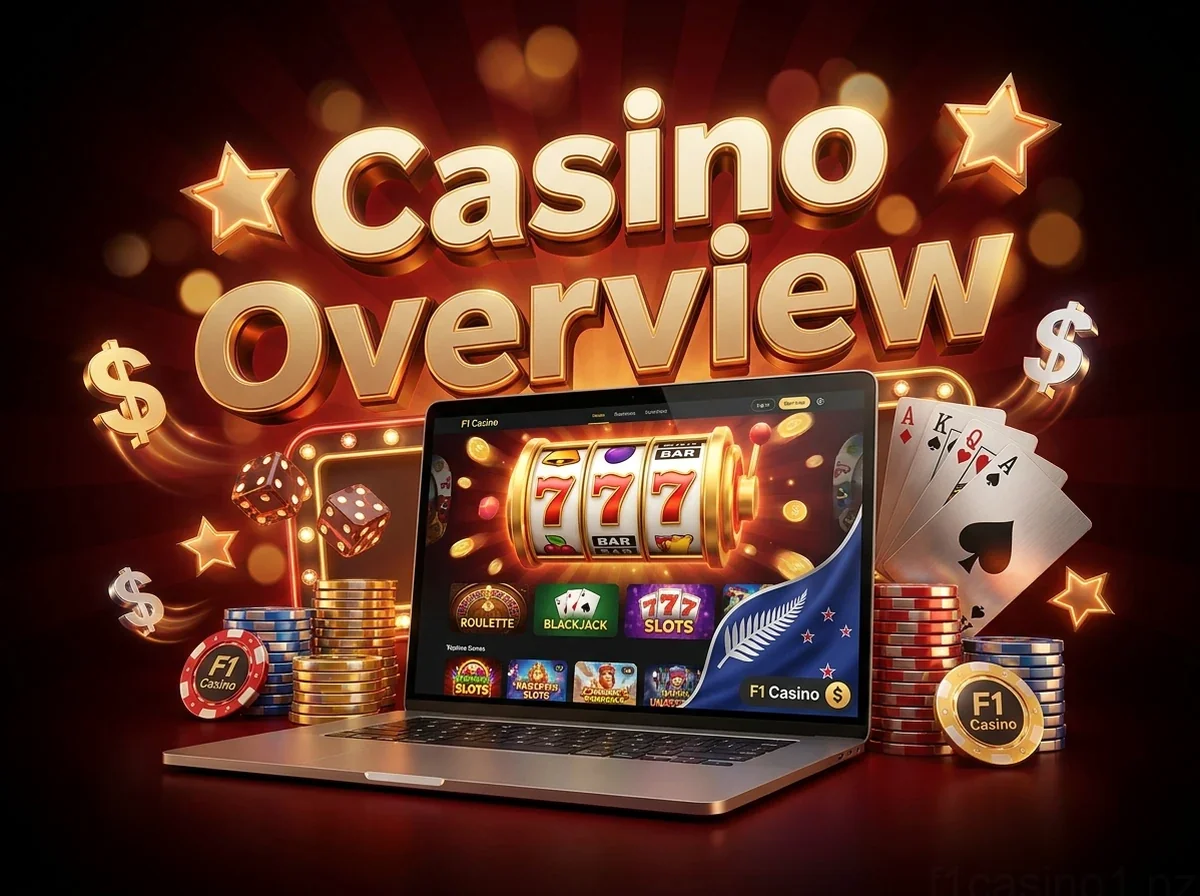
F1 Casino positions itself as a broad-spectrum online gaming site, offering pokies, table games, and live dealer products through a web-based platform designed to work across desktop and mobile browsers. Like most offshore operators serving the New Zealand market, it does not require a downloadable app, instead relying on an instant-play interface that adjusts to smaller screens.
The account registration process generally mirrors what is standard across the offshore casino sector: an email and password sign-up, followed by identity verification requirements that are usually triggered before a first withdrawal rather than at registration. This verification step, often called KYC (Know Your Customer), typically requires a photo ID, proof of address, and sometimes a selfie or payment method confirmation.
What a New Zealand player should expect on sign-up
New players researching F1 Casino NZ access should expect a process broadly similar to other offshore sites, though exact requirements can vary by operator and by the payment method chosen.
- Email verification link sent immediately after registration
- Currency selection — check whether NZD is offered directly or funds are converted from USD/EUR
- Identity document upload requested before larger withdrawals
- Optional self-exclusion and deposit limit settings in account preferences
One practical point worth flagging for Kiwi readers: because F1 Casino operates offshore, customer support, dispute handling, and terms enforcement are governed by whichever licensing authority the operator holds, not by New Zealand law. This does not mean problems are guaranteed, but it does mean the usual New Zealand consumer protection channels (such as the Commerce Commission or Disputes Tribunal) are unlikely to have jurisdiction over an offshore gaming dispute.
Game Library

The strength of an online casino is frequently judged by the breadth and quality of its game library, and F1 Casino pokies form the core of that offering. A typical offshore library of this type draws content from multiple third-party software studios rather than developing games in-house, which means the fairness of individual titles depends on the certification standards of each provider rather than the casino itself.
Pokies dominate the catalogue by volume, ranging from classic three-reel titles to elaborate video pokies with bonus rounds, cascading reels, and progressive jackpot networks. Table games — blackjack, roulette, baccarat, and various poker variants — are usually available in both standard RNG (random number generator) format and live dealer format, where a real dealer streams the game via video to players' devices.
Common software providers found on offshore platforms
While exact studio partnerships can change over time, offshore operators serving the NZ market commonly source content from a recognisable pool of international developers. The presence of well-known studios is a reasonable, though not definitive, signal of game-level fairness, since these developers submit their random number generators for independent testing.
Audited game suppliers
The casino partners with certified game developers including Pragmatic Play, Microgaming, and NetEnt—all providers audited by independent testing labs like GLI and eCOGRA. This ensures fair RNG certification and transparent payout verification across their game portfolio.























- Pragmatic Play — video pokies and live dealer tables
- Evolution Gaming — live dealer studios
- NetEnt — established video pokies catalogue
- Play'n GO — themed pokies with bonus features
- Microgaming — long-running pokies and jackpot networks
| Category | Examples | Typical RTP range |
|---|---|---|
| Video pokies | Themed 5-reel titles | 94%-97% |
| Classic pokies | 3-reel fruit machines | 92%-96% |
| Progressive jackpots | Network-linked pokies | Variable, lower base RTP |
| Live dealer tables | Blackjack, roulette, baccarat | House edge varies by game rules |
Return to Player (RTP) figures represent the theoretical percentage of wagered money a pokie returns to players over a very large number of spins. It is a long-term statistical average, not a short-term prediction, and it says nothing about the outcome of any individual session. Independent testing laboratories such as iTech Labs and eCOGRA are commonly cited across the industry for auditing RNG fairness and confirming that published RTP figures match the actual game code — checking whether a specific title carries such certification is a useful due-diligence step before playing.
How casino game mechanics work
Understanding the mechanics behind online pokies helps explain why outcomes cannot be predicted or influenced by strategy in the way some players assume. Every spin on a certified online pokie is generated independently by a Random Number Generator, a piece of software that produces a new, unpredictable result each time the game is triggered — regardless of what happened on the previous spin or how much has been wagered in that session.
This independence is the mathematical foundation of fairness. A pokie does not "remember" previous losses, does not become "due" for a win after a losing streak, and does not adjust its behaviour based on bet size beyond the proportional payout scaling built into its paytable. The RNG is typically seeded continuously, meaning it generates results even between spins, so there is no pattern a player could theoretically time or predict.
Volatility (sometimes called variance) is a separate concept from RTP and describes how a pokie distributes its payouts over time. A low-volatility pokie tends to pay smaller wins more frequently, while a high-volatility title pays out less often but with the potential for larger individual wins. Neither structure is inherently better; the choice affects bankroll management and session length rather than long-term return, since RTP is calculated independently of volatility.
Bonus features such as free spins, multipliers, and cascading reels are programmed into the same RNG-driven system, meaning their trigger frequency is also randomised within the game's mathematical model. Reputable providers publish or make available paytables showing the odds and contribution of these features, and independent labs check that these published figures match what the game actually delivers in testing. Recognising this structure helps explain why no betting pattern, timing strategy, or "hot machine" belief can reliably influence outcomes on a properly certified RNG pokie.
Most-played slots at F1 Casino
F1 Casino offers a solid selection of popular slots across different volatility levels. Power of Thor Megaways (96.55% RTP) and Aztec Gems Deluxe (96.52% RTP) from Pragmatic Play provide strong return rates, while titles like Bier Haus and Lucky Lady's Charm Deluxe cater to players seeking classic gameplay.


































Banking
Payment flexibility is one of the most practical concerns for New Zealand players using offshore platforms, particularly since some New Zealand banks apply extra scrutiny or block card transactions linked to overseas gambling merchants. Because of this, many Kiwi players researching F1 Casino NZ options pay close attention to e-wallets and cryptocurrency as practical alternatives to bank cards.
Deposit and withdrawal processing times vary significantly by method. E-wallets and cryptocurrency transactions tend to process faster on both ends, while bank transfers and card payments can take longer for withdrawals, partly due to the additional verification checks offshore operators apply to larger cashouts. Crypto payments in particular have become popular among Kiwi players specifically because they are not subject to the same bank-level blocks that sometimes affect card deposits to overseas gambling sites.
Payment methods commonly available at offshore operators
The table below summarises payment categories typically seen at offshore platforms like F1 Casino, along with general characteristics. Exact options can vary and should always be confirmed directly on the operator's banking page before depositing.
| Method | Typical speed | NZD support | Notes |
|---|---|---|---|
| Cryptocurrency (BTC, ETH, USDT) | Minutes to hours | Converted at deposit | Avoids bank-level card blocks |
| E-wallets | Same day to 24 hours | Varies by provider | Faster withdrawal processing |
| Bank transfer | 1-5 business days | Often direct NZD | Subject to bank scrutiny on overseas transfers |
| Debit/credit card | Instant deposit, slower withdrawal | Direct NZD possible | Some NZ banks restrict gambling transactions |
Before relying on any single payment method, it is worth reviewing a short checklist to avoid common friction points during withdrawal.
- Confirm whether identity verification is required before the first withdrawal, not after
- Check minimum and maximum withdrawal limits per transaction and per month
- Review whether withdrawal method must match the original deposit method
- Note any processing fees applied to specific payment types
A recurring pitfall for New Zealand players is assuming a payment method advertised on a casino's homepage will always work smoothly from an NZ bank account. Bank-side declines related to overseas gambling transactions are a bank policy issue, not necessarily a fault of the casino, which is another reason crypto and e-wallets have grown in relevance for the NZ market.
Licensing & Safety
Licensing is the area where New Zealand players most need accurate, up-to-date information, because the regulatory landscape is actively changing. As of the time of writing, New Zealand does not yet have any Department of Internal Affairs (DIA / Te Tari Taiwhenua) licensed online casino operators. The Online Casino Gambling Act 2026 comes into force on 1 May 2026 and creates the country's first-ever domestic licensing regime for online casino gaming, with up to 15 licences to be allocated during 2026 and issued from 1 December 2026, with the full regime becoming operational through 2027.
This means that F1 Casino, like every other online casino currently accessible to New Zealanders, operates offshore under a foreign licence rather than a New Zealand one. Offshore operators in this space commonly hold licences from authorities such as the Malta Gaming Authority (MGA), the Government of Curaçao, or the Kahnawake Gaming Commission. These are legitimate international regulatory bodies that impose their own standards on operators, but it is essential to understand what they do not do.
A Curaçao, MGA, or Kahnawake licence is a foreign authorisation. It is not a New Zealand licence, and it does not mean the operator is regulated, licensed, or endorsed by the New Zealand government or the DIA.
What offshore licensing does and does not provide
Understanding the practical difference between foreign licensing and New Zealand oversight helps set realistic expectations for dispute resolution and consumer protection.
- Foreign licences typically require operators to use certified RNG software and maintain segregated player funds
- Foreign regulators may offer a complaints process, but it operates under that jurisdiction's rules, not New Zealand's
- SSL encryption protects data in transit between a player's device and the casino's servers, which is a technical security measure, separate from licensing
- No foreign licence grants access to New Zealand's Disputes Tribunal, Commerce Commission, or any local regulatory recourse
It is also important to be precise about legality for individual players. Under New Zealand law, it is not a criminal offence for an individual to play at an offshore online casino — the Online Casino Gambling Act 2026 and the broader Gambling Act primarily target unlicensed operators and the advertising of offshore gambling to New Zealanders, not the players themselves. However, playing offshore means forgoing the consumer protections, complaint pathways, and oversight that the incoming DIA-licensed regime is specifically designed to provide once it is fully operational from December 2026 onward.
Kiwi players should treat any online casino New Zealand search results with this context in mind: until DIA-licensed operators go live, every available option is an offshore site operating under foreign law, and none can accurately be described as "licensed in New Zealand," "DIA-regulated," or "legal in New Zealand" in the way that phrase would apply once the new regime is active.
How to Start
Sign up with an email and password. An email verification link is sent immediately after registration.
Photo ID, proof of address and sometimes a selfie — usually requested before larger withdrawals.
Choose crypto, e-wallet, card or bank transfer. Check whether NZD is direct or converted from USD/EUR.
Pick pokies or live tables. Set deposit and loss limits in account preferences before you play.
Pros & Cons
Pros
- Broad game library of pokies, table games and live dealer titles
- Content from established studios such as Pragmatic Play, NetEnt and Evolution
- Payment flexibility with crypto and e-wallets that avoid bank-level card blocks
- Instant-play interface across desktop and mobile browsers, no app required
- Operator self-exclusion and deposit limit tools available in account settings
Cons
- Not licensed by the New Zealand Department of Internal Affairs (DIA)
- No access to NZ's Disputes Tribunal or Commerce Commission for disputes
- NZ national self-exclusion register cannot yet block offshore sites
- Some NZ banks may restrict or decline card gambling transactions
Responsible Gambling
Responsible gambling is not a secondary consideration — it is central to how any casino guide should be written, and it applies whether a player is using an offshore site today or a DIA-licensed platform once the new regime launches. Online casino gaming in New Zealand is restricted to players aged 18 and over, and this age threshold applies regardless of which jurisdiction licenses the specific operator.
Practical tools for safer play
Because F1 Casino operates offshore rather than under DIA licensing, New Zealand's forthcoming national online self-exclusion register — mandated to be in place by December 2027 — is not yet available and cannot currently be used to block access to this or any offshore site. Until that register is live, players wanting to limit or stop their play need to rely on tools offered directly by the operator, supplemented by independent software.
- Use the casino's own account settings to set deposit limits, loss limits, or session time reminders
- Request temporary self-exclusion or full account closure directly through the operator's support channels
- Install independent blocking software such as Gamban or GamBlock, which restrict access to gambling sites at the device level regardless of which casino is used
- Review bank or card provider options for blocking gambling transaction categories directly
These tools are most effective when used proactively rather than after a problem has already developed. Setting a deposit limit at account creation, for instance, is generally more effective as a safeguard than trying to impose discipline mid-session. It's also worth remembering that no bonus, strategy, or betting pattern changes the underlying mathematics of a certified RNG game, so gambling should always be treated as entertainment with a real cost, not a way to generate income.
FAQ
Is F1 Casino legal for New Zealand players?
It is not a criminal offence for an individual New Zealander to play at an offshore online casino such as F1 Casino. However, the platform is not licensed by the Department of Internal Affairs, because no operator currently holds a DIA licence — these are being issued from 1 December 2026 under the Online Casino Gambling Act 2026. F1 Casino operates under whichever foreign licence it holds, which is not a New Zealand authorisation.
Does F1 Casino accept NZD?
Many offshore platforms support NZD directly for deposits and withdrawals, while others process transactions in USD or EUR with conversion applied. This should be confirmed on the casino's banking page before depositing, and it can affect the value received due to conversion fees or rates.
What is the minimum age to play at F1 Casino?
Online casino gaming in New Zealand carries an 18+ minimum age requirement. This applies to any online casino accessed by a New Zealand resident, regardless of where the operator is licensed.
Are F1 Casino pokies fair?
Individual pokie titles are typically developed by third-party studios such as Pragmatic Play, NetEnt, or Microgaming, whose RNG software is commonly tested by independent labs like iTech Labs or eCOGRA. Checking whether a specific title carries such certification is a reasonable way to assess fairness at the game level, separate from the casino's own licensing.
Can I self-exclude from F1 Casino?
Yes, through the operator's own account tools or by contacting support to request account closure or a self-exclusion period. New Zealand's national self-exclusion register is not yet live (it is mandated by December 2027), so it cannot currently be used to block offshore sites like F1 Casino — independent tools such as Gamban or GamBlock can provide an additional layer of control in the meantime.
Will DIA-licensed casinos replace offshore sites like F1 Casino?
Once the Online Casino Gambling Act 2026 regime is fully operational, DIA-licensed operators will offer New Zealand players a locally regulated alternative with domestic consumer protections. Licences are being allocated during 2026 and issued from 1 December 2026, with the broader regime becoming operational through 2027, so this transition is still underway rather than complete.
How long do F1 Casino withdrawals take?
Deposit and withdrawal processing times vary significantly by method. E-wallets and cryptocurrency transactions tend to process faster on both ends, while bank transfers and card payments can take longer for withdrawals, partly due to the additional verification checks offshore operators apply to larger cashouts.
What are wagering requirements at F1 Casino?
A wagering requirement (commonly written as 30x, 40x, or similar) tells you how many times the bonus amount, or the bonus plus deposit combined, must be played through before any winnings can be withdrawn. A NZD 500 bonus with a 40x requirement means NZD 20,000 in total wagering before a withdrawal request can be processed.
Final Verdict
F1 Casino reflects a broader pattern among offshore platforms currently serving New Zealand players: a wide pokies library sourced from established international studios, a familiar bonus structure built around wagering requirements, and payment flexibility that increasingly leans on crypto and e-wallets to work around bank-level restrictions. None of this is unique to F1 Casino — it mirrors how most offshore operators in this space are structured while New Zealand's own licensing regime is still being rolled out.
The most important takeaway for Kiwi readers is contextual rather than promotional: as of today, no online casino, including F1 Casino, is licensed by the Department of Internal Affairs, and no operator can accurately claim to be regulated in New Zealand. Foreign licences from authorities like the MGA, Curaçao, or Kahnawake provide a baseline of operational standards but do not equate to New Zealand consumer protection. Players who choose to use offshore platforms in the meantime should prioritise operators with transparent terms, verifiable RNG certification, and clear self-exclusion tools, while keeping the Gambling Helpline (0800 654 655 or text 8006) and safergambling.org.nz on hand as a safety net.
As the DIA-licensed regime comes online from December 2026, New Zealand players will gain access to a genuinely local alternative with domestic oversight. Until then, informed caution — understanding bonus terms, checking licensing context, and using responsible gambling tools proactively — remains the most reliable approach to engaging with any offshore platform, F1 Casino included.